Ice Caves in Iceland | Explore the Blue Ice Wonders
Step into a world of shimmering blue ice, frozen tunnels, and ever-changing natural beauty. The ice caves in Iceland are among the country’s most breathtaking natural wonders — formed inside the glaciers where light meets ancient ice. From the legendary Crystal Ice Cave in Vatnajökull Glacier to the volcanic black ice of Katla, and new discoveries like the Sólheimajökull Ice Cave and Askur Ice Cave, each glacier reveals a unique frozen landscape that changes every year.
In this guide, you’ll learn everything you need to know before visiting — including the best time to go, what to wear, and which ice cave tours in Iceland offer the most unforgettable experiences.
While many tours use “ice cave” and “glacial cave” interchangeably, there is a subtle difference. An ice cave is generally a natural rock cave that has ice year-round inside. A glacial cave, however, is formed in a glacier itself—an evolving tunnel in the ice. Glacial caves often feature glowing blue ice, crevasses, and ever-changing formations. Because of glacier movement and melt cycles, every season the shapes, textures and colors change—so no two visits are the same.
Why Visit Ice Caves in Iceland?
Unique and ephemeral: Many of these caves only exist for a short time each year.
Stunning visuals: Crystal-clear blue ice, contrasting volcanic ash patterns, raw glacial texture.
Educational and adventurous: Learn about Iceland’s glaciers, geology and climate while adventuring into the ice.
Accessible for many: With guided tours, you don’t need advanced climbing skills—just good footwear and a sense of wonder.
Best Ice Caves to Visit in Iceland
1. Crystal Ice Cave – Vatnajökull Glacier (The Famous Blue Ice Cave)
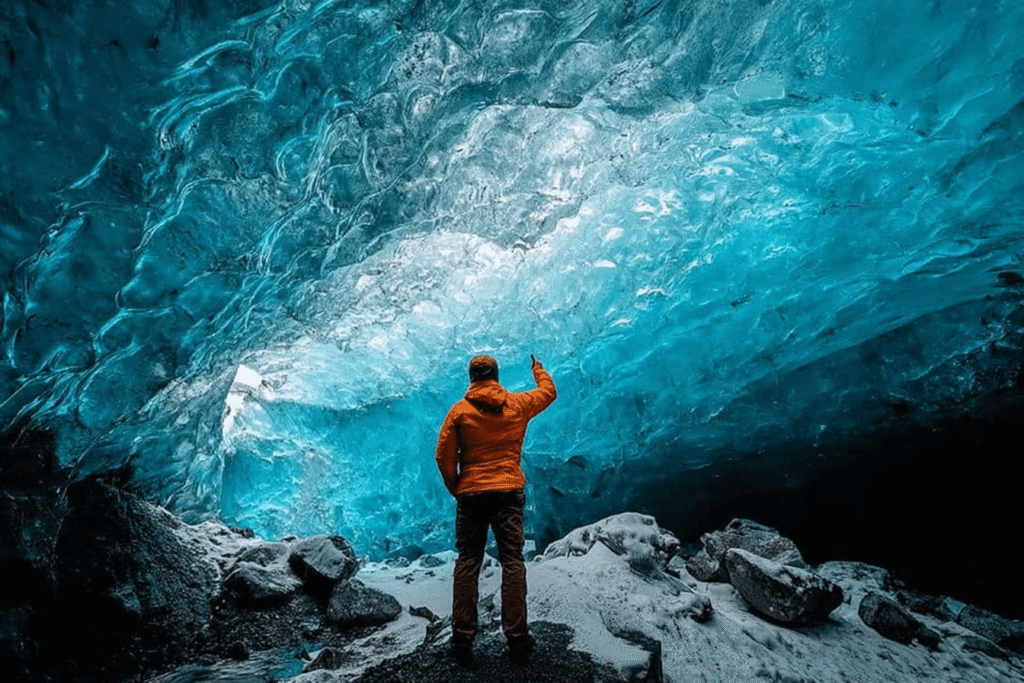
The Crystal Ice Cave is the most famous ice cave in Iceland — and with good reason. Located deep inside Vatnajökull Glacier, Europe’s largest glacier, this cave is renowned for its vast, cathedral-like chambers and impossibly vivid blue tones.
Every winter, certified guides scout and open new routes within Vatnajökull. The most popular tours depart from Jökulsárlón Glacier Lagoon or Skaftafell National Park, taking you across the glacier by Super Jeep before walking into a world of glowing blue ice.
This cave is safe to visit only in winter (November–March) when the ice is stable. The cave’s colors and shapes change each year, making it a truly one-of-a-kind experience every time.
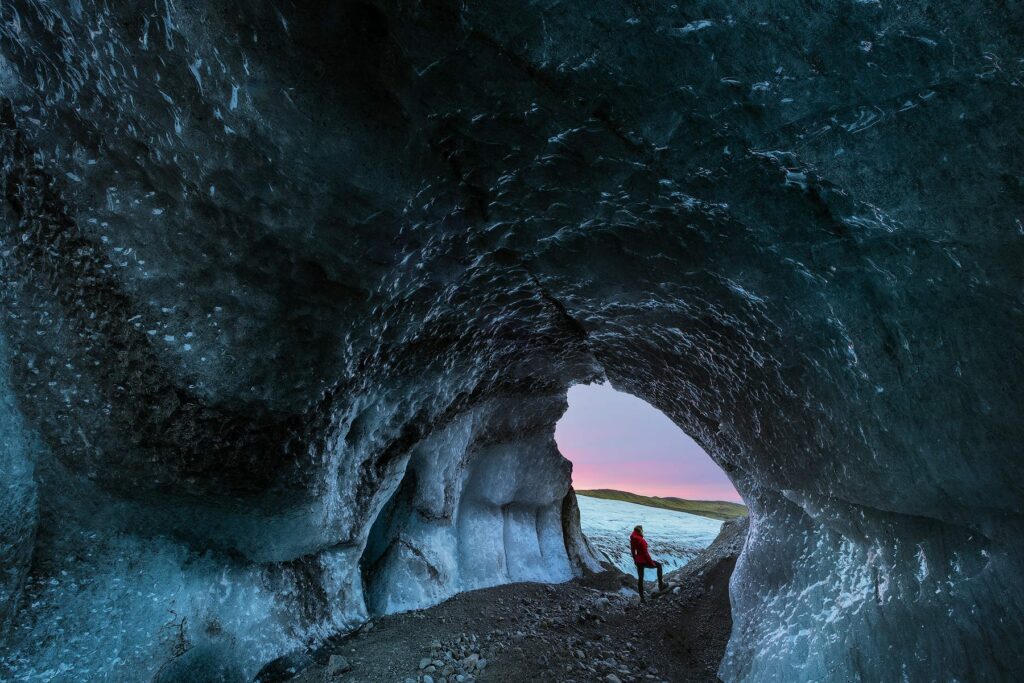
Hidden beneath Mýrdalsjökull Glacier, the Katla Ice Cave is one of Iceland’s most thrilling natural wonders. It sits above the active Katla Volcano, which last erupted over a century ago. The heat and pressure from the volcano mix with the glacier’s movements to form striking layers of black volcanic ash and blue ice, creating a surreal and dramatic appearance.
The Katla Ice Cave is accessible year-round, though conditions are best from autumn through spring. Tours typically depart from Vík or Reykjavík, traveling by Super Jeep through the rugged volcanic landscape before reaching the glacier.
Naturally forming ice caves in Iceland can be of any color ranging from white, opaque, translucent, transparent, blue, crystal violet, and even black. Although black ice caves are pretty rare even for Iceland but not a myth. So little amount of light enters the cave that it appears to be made of black marbles entirely.
4. Askur Ice Cave – The Hidden Gem of Vatnajökull
The Askur Ice Cave is one of the newest and most captivating ice caves discovered in Vatnajökull National Park. “Askur” means “ash tree” in Icelandic — a fitting name for a cave that blends deep blue ice with streaks of volcanic ash from past eruptions.
This cave is often less crowded than the Crystal Cave, offering a quieter and more immersive experience. It’s usually accessible from the Skaftafell or Jökulsárlón area, and tours are available for small groups led by glacier experts.
Inside, you’ll find incredible textures of crystal-clear blue ice, curved tunnels, and fascinating ice formations. If you want something both photogenic and peaceful, the Askur Ice Cave is an excellent choice.
While most ice caves and glacial caves are made naturally when the glacial ice develops cracks, some man-made caves have also been carved in glaciers like Langjökull which contains formations like chapels. These caves or tunnels are very stable and safe to experience the blue that these caves are famous for. They are also used as a spot for the Secret Solstice Festival.
Top Contenders for Your Tour
There are very few ice caves that have been given a name or have been distinguished as an entity since they have been forming at the same place for many years. Some of these caves form for a series of years and then disappear for a while but show up again at the same place after a few years. Hence, a few popular ice caves in Iceland have earned their names for their consistency and the formations they display year-after-year.
Vatnajökull Glacier Crystal Cave
Located in the largest glacier of Europe, the crystal cave of Vatnajökull glacier is one of the most visited caves in Iceland by the tourists. Vatnajökull covers about 8% of Iceland and is spread over an area of 7,900 km sq2. As expected of the Vatnajökull glacier, the crystal ice cave that it houses is one of the biggest ice caves in Iceland and is known for the fabulous formations that it holds in so many variating shades of blue. It is carved at the same place almost every year by the glacial river of Vatnajökull – the largest glacial river in Iceland. Vatnajökull has about 30 glacial outlets many of which have their own glacial ice cave formations popular among the tourists.
The glacial cave is also known by the name of Anaconda Ice Cave due to its long, cylindrical structure and for being incredibly spacious. The crystal blue color of the ice is thanks to the hundreds and thousands of years of compression by the glacier’s weight. It pushed out the air molecules and made a closely packed block of ice which is later carved by the river into a cave forming a crystal blue ceiling of ice. Completely out-of-the-world, this wonderful ice cave should be on top of your list. It is about a 5-hour long drive from Reykjavik before you reach Vatnajökull glacier located in South-east Iceland. You will be taking a small hike to reach the cave.
Langjokull Ice Caves: The Unusually Patterned Caves
Langjokull glacier is the second-largest glacier of Iceland and contains man-made and natural ice caves. The most popular natural ice cave of this glacier is not a blue ice cave but rather a black and white one. It has a white ice ceiling that features beautiful black-colored patterns made by the ashes from volcanic eruptions. With quirky formations like a turquoise blue rivulet in the ceiling, a cylindrical pole in the middle of the cave Langjokull ice cave. The column or the pole changes its appearance every year.
The reason this tour is so popular even though the cave is rather small in size is that the ride to Langjokull glacier is very thrilling and adventurous. It is located very close to the capital city and one needs to take huge super trucks to get there. It can also be made a part of your day trip to the Golden Circle.
Apart from the natural caves, Langjokull glacier also has some man-made caves dug into it. They are very stable and very-well lit. Sometimes used for festivals, you will find benches on the sides to rest, perfectly carved tunnels, and even chapels.
One of the most difficult caves to access, the waterfall ice cave is one of the very few untouched wonders of Iceland which retain their original glory every passing year. This cave is named due to the fact it forms around a waterfall from the surrounding mountains of Vatnajökull glacier. This is the only ice cave located in the east of the Jökulsárlón glacier lagoon. It contains a beautiful bubble warp patterned ceiling with blue, green, and black colored ice.
A 30 to 40-minute-long hike needs to be conquered before you get to the cave. The hike is a thrilling and rewarding experience in itself and it gets better when the destination is as beautiful as the cave. Make sure to get a shot of both the ceiling and the floor in one frame – it is as if both are mirroring each other. It takes about 4 hours to drive from Reykjavik to this location.
Glacier Cave by Katla Glacier-Volcano
A combination of thrill and beauty – the ice cave of Katla volcano is one of the newest discoveries in the field. Katla volcano has several caves to its name but most of them do not get as much light and do not contain a lot of blue ice formations. But they have a beauty unique to themselves – black ice. Visiting these caves is a packaged deal for all the adventure lovers out there. The height to the ceiling is rather low at some points in the cave so you may have to crawl on all fours a lot. But the views you will get in these are second to none. Katla is seen as one of the most unstable and dangerous volcanoes of Iceland. The bubble wrap pattern ceilings, the black walls of the caves with a hint of blue – everything will have you mesmerized in a matter of seconds.
An outlet glacier of Vatnajökull, Svínafellsjökull glacier has its ice cave which can be simply entered through the beach. This gorgeous cave has beautiful slabs of white ice as well as blue ice ceiling which are only 4 meters in height. The entrance starts big and as you walk further into the cave, it beings to get smaller. With beach water beneath your feet and a beautiful blue ice ceiling above your head, it is almost as if you are standing right in between a water tunnel that has been frozen in time. The views inside the cave as well as from the cave are marvelous. Head to the east along the south coast to get to this cave. The ride will last about 5 hours.
Kverkfjöll ice caves lie to the north-east of the of Vatnajokull glaciers in the highlands. The mountain range that is home to these caves is about 1,764 meters high and contains many active volcanoes in the vicinity. Here you will be able to experience the extremely rare sight of a hot water river flowing beneath a glacial cave. The way to these caves is as difficult as they are rare. The nearest landmark that you will be able to find is Sigurðarskáli hut. It will be a 3-kilometer, long hike after that before you can reach the cave.
Honorable Mentions – The Caves That Often Vanish
Blue Diamond Cave: Vatnajökull Glacier
Another marvel from the depths of Vatnajökull glacier, the Blue Diamond cave is much smaller than the Crystal Ice Cave of Vatnajökull and can only fit 17 people at a time. Blue Diamond is an exceptional kind of cave since it is a horizontal moulin cave. Such as glacial caves are carved by the glacial river, moulin caves are carved by meltwater from the glacier. But moulin caves are vertical and cylindrical. However, Blue Diamond is a horizontal cave. The colors featured in this cave are even more diverse than the Crystal Cave of Vatnajökull. The blue is a lot more vibrant and reflects light trapped inside the block of ice giving a similar glittering effect that a diamond has.
The Dark Rubin
Another one of the rarest and the most special ice caves of Iceland, the Dark Rubin, as evident by the name, is completely made up of black ice. A very little amount of light can reach the insides of the cave and hence the black ice can be seen glimmering slowly in the dim light. No amount of words will be able to do justice to the beauty and aura that this cave has. The light that enters the cave creates a beautiful effect on the ice making crystal blue striped patterns on the jet-black ice. Not many people visit this cave due to the rare availability but it is not something to be missed out on at any time it is open for visitors.
Northern Lights Ice Cave
Discovered a few years ago, this stunning cave was named after the Northern Lights or the Aurora Borealis because of the pattern that the ceiling of this cave featured. The crystal blue ceiling had beautiful fine lines that resembled the view of the northern lights in Iceland. The cave has been inaccessible for a few years now but despite its unavailability and instability of formation, it was given a name – solely for the exceptional beauty that it was.
Dressing Up for the Ice Cave Tours
Ice caves are not going to be any warmer than the glacier itself so be very sure to layer-up properly before you set out to explore the unknown. The most basic things you will need on your trip to the caves are:
A shell jacket – must be waterproof and windproof
Waterproof pants
Warm, Insulated Jacket as the second layer
A layer of a comfortable, light but a warm sweater, jacket or hoodie
Breathable base layer t-shirt
Stretchable and comfy pants, joggers, yoga pants or jeggings
Warm base layer pants
Sturdy hiking boots
Proper headgear – warm woolen caps will be best
Heavy gloves – 3-layer gloves will be a great choice
Safety Measures for Your Trip
Never head to a glacial or ice cave without a certified guide. Book with a tour agency fist and get into the cave only when a guide is accompanying you. If you do not want to travel with a group, private tours can be booked. This will mean that you will have a personal guide dedicated to your party but it would grant you exclusive access to the cave. There may be other people inside of the cave.
Weather conditions are going to be harsh so be prepared in advance for them. Follow the instruction of your tour guide and you should be able to enjoy a fun time in the caves.
The state of glacial or ice caves is directly related to the form and movement of the glacier. So, there is no telling when a cave will deform and will be inaccessible. This also means that caves are fragile and you must not do anything to harm the structures inside.
If hiking is involved it the ice cave tour, the touring guide will provide you with the necessary equipment. Make sure that you wear everything properly and stay with the group during the tour.
Popular Articles
Katla Ice Cave – The Only Year-Round Ice Cave in Iceland
How Many Days Do You Really Need in Iceland?
5 Mistakes Travelers Make Planning an Iceland Itinerary
2026 Solar Eclipse in Iceland: How to Experience the Total Eclipse
Bubble and Igloo Hotels in Iceland: Northern Lights Hotels | Map