You can go dog sledding in Iceland all year. Near Reykjavík, in Mosfellsdalur, husky sledding tours run year-round on snow or on wheeled carts depending on conditions, while in North Iceland around Lake Mývatn and Akureyri the tours are on snow from roughly November to May. Most tours last one to two hours, with 35 to 70 minutes behind the dogs. Only a few kennels run tours and places are limited, so book well ahead.
What is dog sledding?
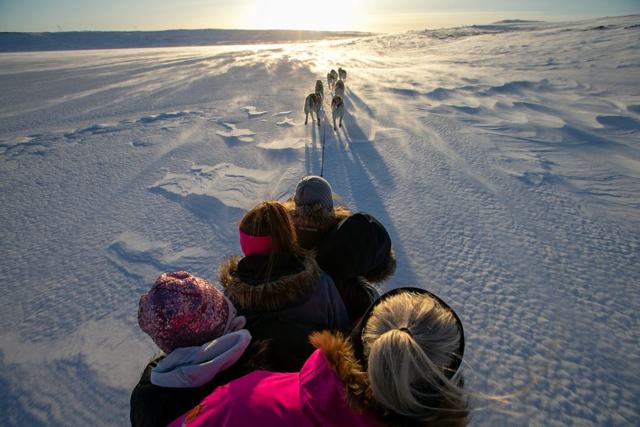
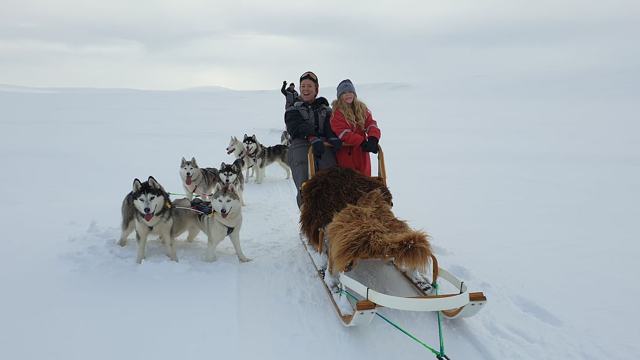
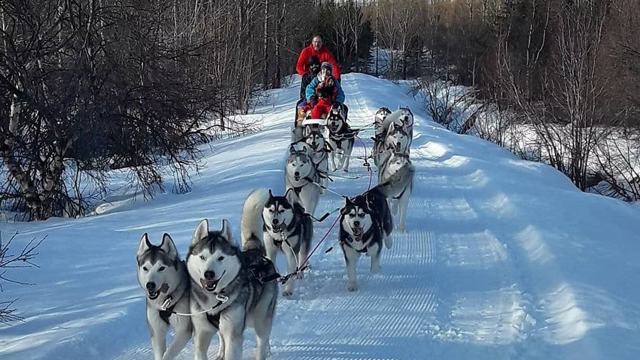
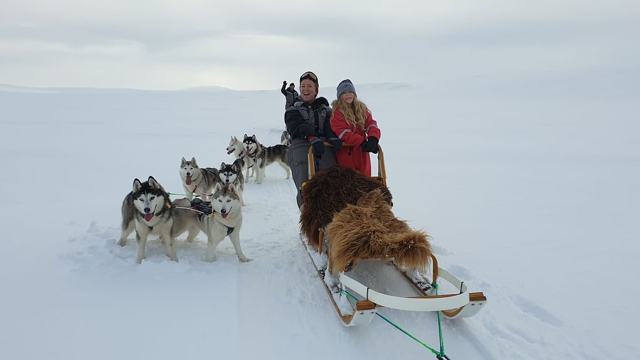
Dog sledding, also called mushing or husky sledding, is a ride on a sled pulled by a team of dogs. The team pulls a sled over snow, or a wheeled cart over dirt tracks when there is no snow. A musher (the dog driver) stands at the back, controls the team and tells the dogs when to run, turn and stop. You ride as a passenger, and on some tours you swap places with other guests during the ride so everyone gets a turn at the front.
Teams usually have between 4 and 10 dogs, depending on the weight of the sled and the trail. A standard sled takes two guests plus the musher, and larger sleds and carts take four or five, which suits families. Ask when you book if you want to ride together.
The ride goes through open valley and mountain scenery, and it is faster and quieter than most people expect. Halfway through there is normally a stop for photos, and at the end you have time to meet, pet and cuddle the dogs. Sled dogs are trained to work around people and are friendly with guests.
If you would like to stand on the runners or help drive, ask when you book. Some mushers allow it when the conditions are right, but it is their decision.
Dog sledding is not an old Icelandic tradition. It only became popular here in the 2000s, and the dogs are bred and trained by the small number of kennels that run tours today.
Where to go dog sledding
There are two main areas. Both are easy to reach, and pickup is available on some tours.
Near Reykjavík (Mosfellsdalur). The kennels are in and around Mosfellsdalur, by the town of Mosfellsbær, about 20 to 35 minutes' drive (roughly 20 km) from the city centre, towards Þingvellir. The trails stay close to the kennels, not past Gullfoss or Geysir as some older guides claim. It fits well at the start or end of a Golden Circle day. Year-round tours here usually run on weekdays only, so check the day before you plan around it. Choose Dog Sledding near Reykjavík for the year-round tour, or Winter Dog Sledding in Iceland for the December to March snow tour.
North Iceland (Mývatn and Akureyri). Winter snow is much more reliable in the north. Tours run from a farm between Akureyri and Mývatn, and from around Akureyri itself. You can combine a ride with Dimmuborgir, Earth Lagoon or Goðafoss on the same day. Book Snow Dog Sledding in Mývatn or Dog Sledding in Akureyri depending on where you stay. If there is little snow, tours may move to higher ground, and you are told the new meeting point the day before.
Driving yourself or pickup. You choose when you book. You can drive to the kennel and meet the team there, or on most tours near Reykjavík add a pickup from your accommodation in the city. In the north you normally drive to the meeting point.
See all our dog sledding tours, or browse North Iceland tours if you are heading north.
What is the best time for dog sledding: snow or dry land?
There is no single best time. Dog sledding runs in every season, and what changes is the surface and the scenery: snow-covered mountains in winter, green valleys and long light in summer, and warm colours in autumn.
On snow, in winter. Snow sledding near Reykjavík usually runs from December to March, sometimes into early April, when there is enough snow. In the north the snow season is longer, roughly November to May. Snow near the capital is never guaranteed, even in January. If there is not enough, winter tours switch to wheeled carts with the same dogs.
On dry land, in summer and autumn. From about May to November, tours near Reykjavík use wheeled carts on gravel tracks, usually pulled by four to eight huskies. It is the same idea: a team of dogs, a musher and a fast ride through the valley. It is a good choice for summer visitors who want to meet the dogs, and you do not need to feel you are missing out.
If riding on real snow matters to you, go to North Iceland between December and March, or book a winter tour near Reykjavík and accept that it may move to carts. Winter also gives you the chance to see the Northern Lights in the evening; see our Northern Lights guide.
Prices, duration and age limits
Tours on our site currently start from about 34,900 ISK per person for the year-round tour near Reykjavík, around 40,000 ISK for snow tours in the north, and around 49,900 ISK for the winter snow tour near Reykjavík. Prices change by season, so check the tour page for the current rate. Hotel pickup from Reykjavík is an optional extra on some tours.
Total tour time is usually 1 to 2.5 hours, including a safety briefing, the ride and time with the dogs. The ride itself is around 35 to 45 minutes near Reykjavík and 45 to 70 minutes on the longer northern tours.
Rules vary by tour, but common limits are:
- Minimum age from 4 to 6 years on most tours, though some winter tours have no minimum and small children ride with an adult
- Maximum weight of about 95 kg per person on some tours
- Not suitable during pregnancy
- A reasonable level of fitness, as you need to sit steadily on a bumpy ride
Know the popular breeds: huskies and Greenland dogs
Icelandic kennels use three main types of sled dog. Alaskan huskies are not a formal breed but working dogs bred for speed and stamina. They are lean, with long, strong legs, and come in black, sable and speckled coats. They are usually the fastest dogs in a team.
Siberian huskies are the classic blue-eyed sled dog, with a thick coat that suits cold weather. They have worked alongside people for a very long time and cope well with hard conditions.
Greenland dogs are one of the oldest dog breeds, larger and heavier, with a thick double coat and great pulling strength. They are loyal, hardworking dogs and look a little like Siberian huskies. Some kennels also have mixed breeds and adopted dogs.
Many teams in Iceland are mostly Siberian huskies, but most kennels mix breeds. Whichever tour you take, the dogs are used to people and meeting them is a big part of the visit.
Dog sledding with children
Dog sledding is one of the easier adventure activities to do as a family. Children ride in the sled with an adult and the dogs are used to young visitors. Check the minimum age for your tour before you book.
Children feel the cold sooner than adults, and they sit still for most of the ride. Dress them a layer warmer than yourself, with mittens, a hat that covers the ears and warm boots. In summer bring a sun hat and a spare jumper. If a child is nervous around dogs, tell the musher at the start so they can be introduced calmly.
Watch the weather: conditions and cancellations
Tours only run when the weather and trail conditions are safe for both guests and dogs. Strong wind, heavy snow or storms can cancel or shorten a tour, and in winter the roads to the kennels can be affected too. If your tour is cancelled by the operator you are normally offered another date or a refund.
Check the forecast on vedur.is and road conditions on road.is the day before, especially if you are driving yourself in winter. If a tour does get cancelled, our guide to alternatives when your tours get cancelled has ideas.
What to wear and a few things to bring
Dress as if you were going skiing. You sit still in cold air for up to an hour, and the wind chill on a moving sled is real. Most tours provide warm, waterproof overalls, and some lend hats, but bring your own layers. Even in summer, pack a warm jacket, extra socks and a warm layer.
- Thermal base layer (long underwear)
- Wool or fleece jumper
- Waterproof jacket and trousers
- Warm, waterproof boots that come above the ankle
- Hat, warm gloves and a scarf or neck warmer
- Sunglasses or ski goggles for low winter sun, snow glare and flying snow
- In summer: sunglasses, a hat, sunscreen and a waterproof jacket, plus a warm layer
- A camera or phone with a wrist strap, and a spare battery in winter, since cold drains batteries fast
The ethical debate: is dog sledding ethical?
It is a fair question. Some people feel that using dogs for tours is exploitation. Others point out that sled dog breeds are bred to run and pull, and that working dogs which are well fed, rested and cared for usually enjoy it. What matters is how each kennel treats its dogs.
Signs of good care include short runs with rest time, regular health checks, tours stopped in unsafe weather or heat, teams sized to the load, and dogs that look relaxed and approach people happily. Rides are kept to about an hour or less partly for the dogs' sake, and weight limits on passengers exist to protect them.
You have a part in it too. Follow the musher's instructions around the dogs, do not feed them, and ask before you pet a dog you have not met. If you want to know more, ask the kennel how often the dogs run, how they are housed and what happens when they retire. A good kennel is glad to answer.
Combine it with other winter activities
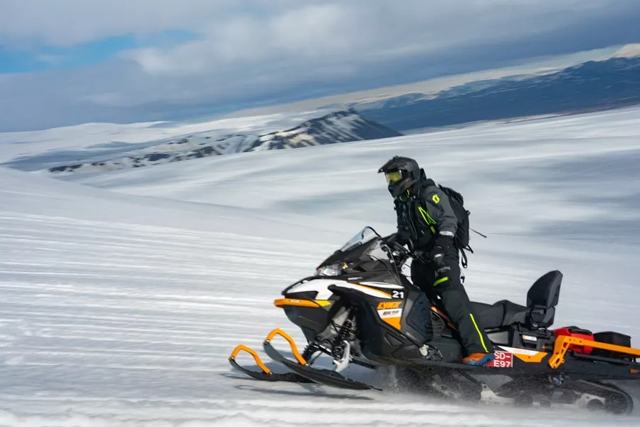
Dog sledding pairs well with other winter trips. Near Reykjavík you can add a Golden Circle day or a snowmobile tour on Langjökull, or book a Private Golden Circle & Snowmobile day. In the north, combine it with Mývatn, whale watching from Akureyri or Húsavík, or a Northern Lights hunt. For horse lovers, a horseback riding tour on an Icelandic horse is another animal experience that runs all year.
For packing and planning help, see our Iceland winter packing list and our guides to Iceland in January and February.
Tours to book
Pick the tour that matches where you stay and how much you want real snow.
- Winter Dog Sledding in Iceland: the winter tour near Reykjavík, on snow when there is enough.
- Snow Dog Sledding in Myvatn: the best chance of a real snow ride, in the north.
- Dog Sledding near Reykjavik: runs all year, so it works for summer visitors too.
Questions people ask
Can you go dog sledding in Iceland in summer?
Yes. Near Reykjavík, tours run all year. In summer and autumn they use wheeled carts on dry land instead of sleds on snow.
Where is the best place for dog sledding on snow in Iceland?
North Iceland, around Mývatn and Akureyri, has the most reliable snow, roughly from November to May. Near Reykjavík, snow tours run from about December to March when there is enough snow.
How much does dog sledding in Iceland cost?
Tours on our site start from about 34,900 ISK per person near Reykjavík and around 40,000 to 49,900 ISK for winter snow tours. Pickup from Reykjavík costs extra on some tours.
Can children go dog sledding in Iceland?
Yes. Most tours accept children from 4 or 6 years old, and some winter tours have no minimum age, with small children riding with an adult.
Do I drive the sled myself?
Usually not. A musher controls the team and you ride as a passenger. On some tours guests swap positions during the ride.
What breeds of dog pull the sleds in Iceland?
Mostly Siberian huskies, Alaskan huskies and Greenland dogs, often mixed in one team.
Do I need to book dog sledding in advance?
Yes. Only a few kennels in Iceland run tours and they are often fully booked, so reserve well ahead, especially for winter.